Why Most Home Service Businesses Stay Stuck Under $1 Million
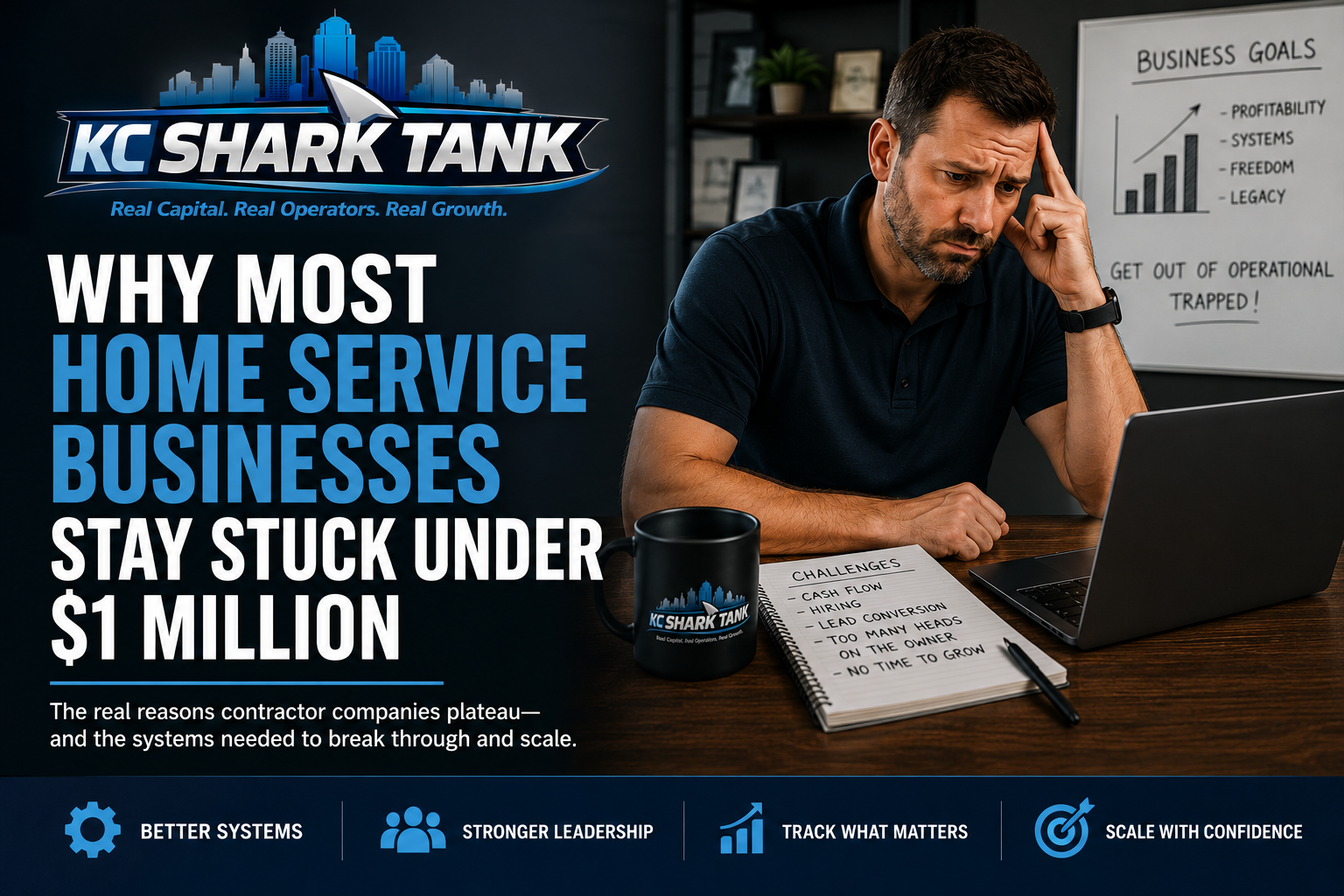
Many home service companies dream about reaching seven figures in annual revenue. However, most businesses never successfully scale beyond that point.
In fact, the problem usually is not effort. Most entrepreneurs work incredibly hard. Instead, the real issue is that many companies attempt to scale without proper systems, leadership structure, operational accountability, or long-term planning.
As a result, business owners often find themselves trapped inside daily operations instead of building scalable companies.
KC Shark Tank was created to help entrepreneurs identify the operational bottlenecks that prevent long-term home service business growth.
Whether a company specializes in roofing, plumbing, foundation repair, HVAC, landscaping, electrical work, or remodeling, the growth challenges are often remarkably similar.
The Early Growth Phase Can Be Misleading
During the startup phase, hustle can cover many operational weaknesses.
For example, owners often:
- Answer every phone call
- Run estimates personally
- Manage crews directly
- Handle scheduling
- Solve customer issues manually
- Oversee sales personally
Initially, this hands-on approach can work surprisingly well. In fact, many businesses grow quickly during the early stages because the owner is heavily involved in every decision.
Eventually, however, growth creates complexity.
More leads require stronger systems. More employees require leadership. Larger revenue requires better financial controls. Meanwhile, operational mistakes become more expensive as businesses continue growing.
Consequently, companies that once felt manageable can suddenly become chaotic.
Why Operational Bottlenecks Kill Growth
Contrary to what many entrepreneurs believe, revenue alone does not create a scalable business.
Instead, growth exposes operational weaknesses that already existed beneath the surface.
For example, many service businesses struggle with:
- Weak follow-up systems
- Poor scheduling processes
- Inconsistent sales training
- Hiring mistakes
- Limited KPI tracking
- Cash flow problems
- Production inefficiencies
- Poor communication
- Weak accountability
- Marketing inconsistency
Unfortunately, these issues tend to compound over time. As a result, many companies become busier while simultaneously becoming less profitable.
Without strong operational systems, growth eventually creates stress instead of freedom.
Why Leadership Matters More Than Most Entrepreneurs Realize
Many business owners believe technical skill automatically creates a successful company. However, leadership is often the true separator between small operators and scalable businesses.
Although technical expertise is important, leadership determines:
- Team culture
- Accountability
- Hiring quality
- Customer experience
- Operational consistency
- Long-term stability
Because of this, companies without strong leadership systems frequently struggle to scale beyond a certain size.
At the same time, businesses with structured leadership often create more predictable growth and stronger employee retention.
Entrepreneurs looking to strengthen operational leadership can learn more through the Business Growth Services available through the platform.
Home Service Business Growth Requires KPI Tracking
One of the most common growth limitations is the absence of measurable business data.
In many cases, entrepreneurs rely heavily on instinct instead of performance metrics. Unfortunately, instinct alone becomes unreliable as businesses grow larger.
Because of this, successful companies consistently track:
- Cost per lead
- Lead conversion rates
- Revenue per employee
- Gross profit margins
- Sales close rates
- Marketing ROI
- Production efficiency
- Customer acquisition cost
- Average ticket value
Specifically, KPI tracking helps business owners identify operational weaknesses before they become major financial problems.
Furthermore, businesses that track performance consistently are often able to make faster and more profitable decisions.
According to the U.S. Small Business Administration, operational planning and financial visibility are essential for sustainable business growth.
Marketing Alone Will Not Solve Operational Problems
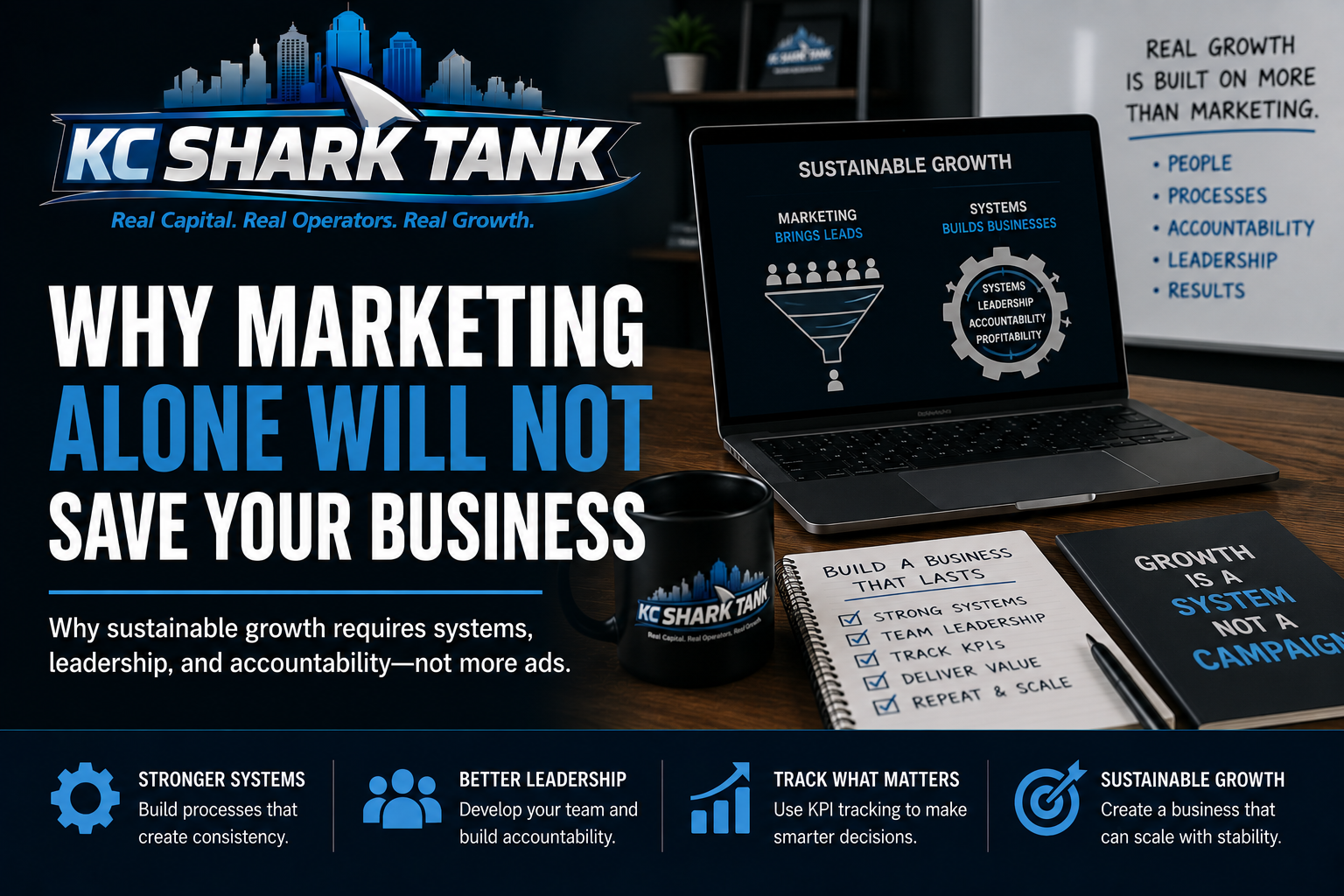
Many entrepreneurs assume additional advertising automatically creates business growth. However, more leads will not solve broken systems.
Instead, additional leads often amplify operational problems that already exist.
For example:
- Poor scheduling becomes worse
- Follow-up delays increase
- Customer communication suffers
- Production mistakes rise
- Team accountability weakens
As a result, companies frequently experience burnout even while revenue increases.
Therefore, successful businesses focus on improving operations and marketing simultaneously.
To help entrepreneurs improve long-term performance, KC Shark Tank focuses on:
- Marketing strategy
- Leadership development
- KPI tracking
- Operational systems
- Accountability structure
- Sales processes
- Team development
- Business growth systems
Additionally, Google Search Central emphasizes the importance of strong website structure, helpful content, and consistent user experience for long-term digital visibility.
Scaling Requires Systems, Not Constant Hustle
In the beginning, hustle can temporarily compensate for weak systems. Eventually, however, sustainable growth requires structure.
Scalable businesses typically rely on:
- Standard operating procedures
- Team accountability
- Defined leadership roles
- Financial discipline
- Hiring systems
- Customer communication processes
- Sales training
- KPI dashboards
- Consistent marketing systems
More importantly, strong systems allow owners to focus on leadership instead of constantly reacting to operational problems.
Consequently, companies with repeatable systems often grow more efficiently while creating less stress for both owners and employees.
Why Some Businesses Break Through While Others Plateau
The businesses that successfully scale beyond $1 million usually share several important characteristics.
For example, they often:
- Track performance consistently
- Build leadership systems early
- Create accountability
- Invest in team development
- Improve operational structure
- Focus on long-term strategy
- Develop repeatable sales systems
- Build scalable marketing processes
Meanwhile, businesses that remain stuck often rely too heavily on the owner for every major decision.
Over time, this creates operational bottlenecks that limit scalability.
Fortunately, those limitations can be corrected with stronger systems, leadership, and accountability.
Mini FAQ About Home Service Business Growth
Why do many home service businesses struggle to scale?
In many cases, companies struggle because they lack systems, leadership structure, KPI tracking, accountability, and operational consistency.
What is the biggest growth bottleneck for service companies?
Operational inefficiency is often the biggest issue. Specifically, weak systems and lack of accountability frequently limit scalability.
Why is KPI tracking important for contractors?
KPI tracking helps businesses measure profitability, identify operational weaknesses, improve marketing ROI, and make better decisions.
Can marketing alone grow a service company?
No. Although marketing generates leads, operational systems are necessary to convert growth into sustainable profitability.
Where can entrepreneurs learn more?
Business owners can learn more through the KC Shark Tank About Page or by contacting the team directly through the Contact Page.
Final Thoughts
Home service business growth requires far more than hard work alone.
Ultimately, scalable companies are built through leadership, accountability, KPI tracking, operational systems, and long-term strategy.
Although many entrepreneurs work extremely hard, sustainable growth only happens when businesses develop repeatable systems that support long-term scalability.
In the long run, companies that prioritize structure and accountability typically outperform businesses that rely entirely on hustle and reactionary decision-making.